Lublin Union Monument
If you’re planning a trip to eastern Poland and Lublin is on your radar — good move. This city punches well above its weight as a cultural destination, and right at the heart of it stands a monument that quietly carries the weight of half a millennium of European history. The Lublin Union Monument isn’t the tallest or the most flamboyant landmark you’ll ever visit, but its story is extraordinary, and once you know what it represents, it becomes one of those rare sights that genuinely stays with you long after you’ve left.
Whether you’re a history enthusiast, a curious first-time visitor, or a concierge looking for meaningful local stories to share with guests, this guide will walk you through everything you need to know about this landmark and why it matters.
The History Behind the Monument — A Union That Shaped a Continent
To appreciate the monument, you first need to understand the event it commemorates. On 1 July 1569, one of the most consequential political agreements in European history was signed right here in Lublin. The Union of Lublin formally united the Kingdom of Poland and the Grand Duchy of Lithuania into a single federated state — the Polish–Lithuanian Commonwealth.
This was no small affair. The Commonwealth that emerged from the Union became one of the largest and most populous states in 16th-to-18th-century Europe. At its peak in the early 17th century, it spanned roughly 1,000,000 square kilometres and had a population of around 12 million people. It stretched from the Baltic Sea to the Black Sea and was home to Poles, Lithuanians, Ukrainians, Belarusians, Jews, and a host of other communities living side by side.
What made the Union truly remarkable for its era was its character. The two nations agreed to share a single elected monarch, a common parliament (the Sejm), a unified currency, and a joint foreign and defence policy — while each retained its own army, treasury, legal system, and administration. Sound familiar? Historians and EU enthusiasts often draw parallels between the principles embedded in the Union of Lublin and those underpinning the modern European Union. Respect for separate languages, freedom of movement, minority rights, and equality before the law were all central to the agreement — radical ideas for the 16th century.
“The Union of Lublin is an example of the integration of nations, cultures and customs, but preserving the most crucial differences, adhering to respect and equality before the law — values very similar to EU legal and formal principles today.”
The original act document was so significant that it was inscribed in UNESCO’s Memory of the World International Register in 2017, submitted jointly by five countries: Poland, Lithuania, Ukraine, Belarus, and Latvia.
The Monument Itself — What You’re Looking At
The Lublin Union Monument stands on Litewski Square (Lithuanian Square) — a name that’s no coincidence. This was historically the encampment of the Lithuanian nobility who travelled to Lublin to take part in the Union parliamentary sessions of 1569. That geographic and historical connection makes the location feel intentional and poignant.
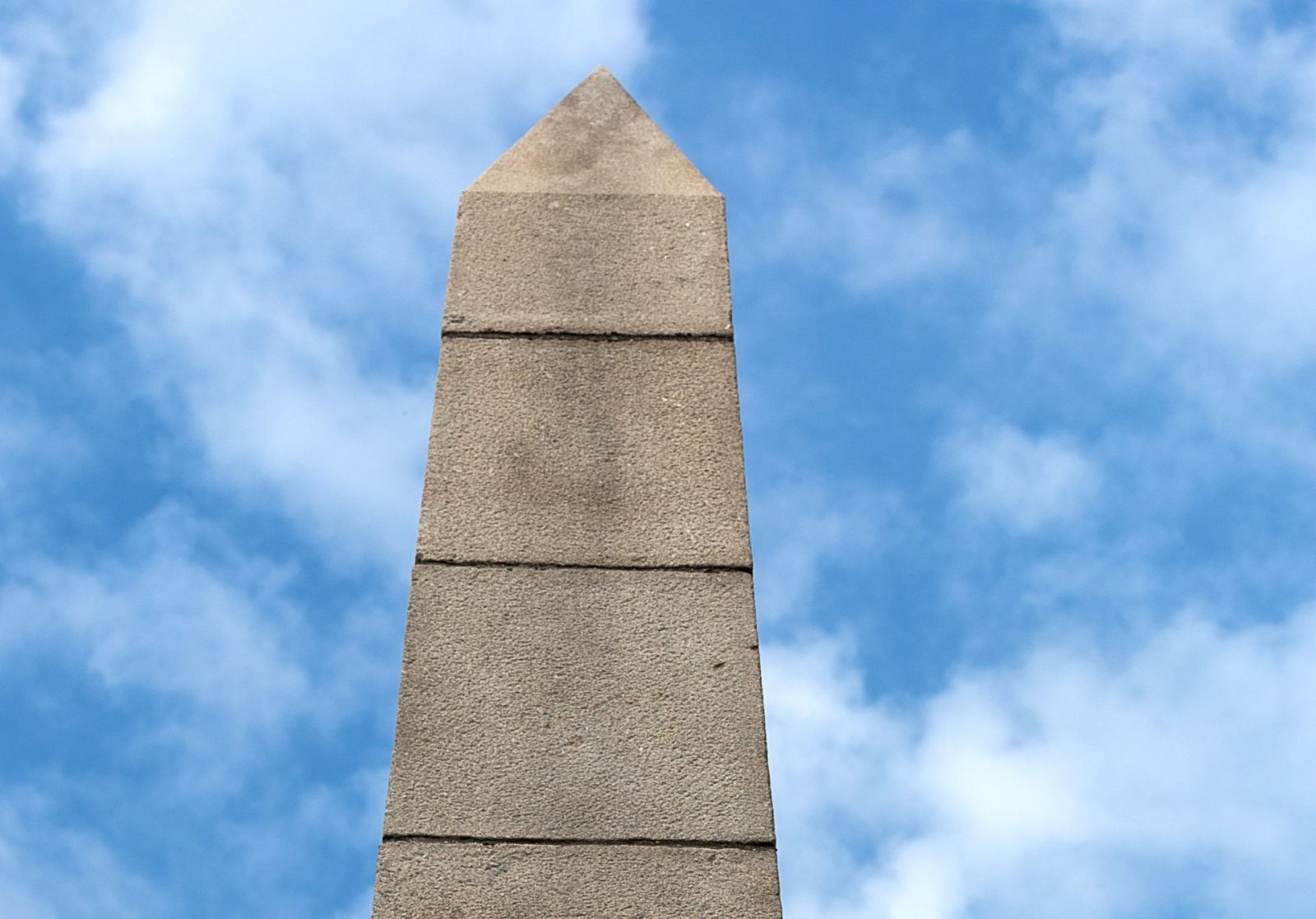
The monument you see today was erected in 1826, on the initiative of the Polish intellectual and statesman Stanisław Staszic, on the site of an earlier monument commissioned by King Sigismund Augustus in the 16th century (which was later destroyed by the tsarist authorities). Here are the key details of what you’ll encounter:
- Form: A cast-iron obelisk, 13 metres tall, set on a brick square platform covered in granite slabs.
- The bas-relief: Designed by artist Paweł Maliński, the front features two female figures representing the Crown of Poland and the Grand Duchy of Lithuania, facing each other and shaking hands. Between them are the coats of arms of both nations — the White Eagle of Poland and the Pahonia (a mounted knight) of Lithuania.
- Inscription: A brass letter inscription runs along a prominent cornice on the pedestal.
- Hidden door: At the back of the lower section of the obelisk, there’s a small door with two locks — a charming detail that invites speculation about what lies inside.
- European Heritage Label: The monument carries the prestigious European Heritage Label, recognising its exceptional role in shaping European history and culture.
The overall aesthetic is dignified and restrained — a neoclassical monument that speaks more through symbolism than spectacle. The handshake between the two personified nations is central to its meaning: unity forged through negotiation and mutual respect, not conquest.
The European Heritage Label — Why It Matters
The European Heritage Label is awarded by the European Commission to sites that have played a significant role in shaping Europe’s values, history, and cultural identity. Lublin was first granted this distinction in 2007, with the Union of Lublin Monument being one of three connected Lublin sites to receive the honour, alongside the Holy Trinity Chapel and the Dominican Church and Monastery of St Stanislaus the Martyr.
This recognition elevates the monument from a local landmark to a site of continent-wide importance. It’s the kind of accolade that puts Lublin in the same conversation as some of the most culturally significant destinations in Europe — and rightly so.
Visiting the Monument — Practical Tips for Travellers
The good news for visitors is that the monument couldn’t be easier to access. Litewski Square is right in the heart of central Lublin, making it an effortless stop whether you’re walking from the Old Town or using it as a starting point for a broader city tour. Here’s what to expect and how to make the most of your visit:
- Access: The monument is outdoors and freely accessible at all times — no tickets required.
- Best time to visit: Morning visits are quieter; evenings are atmospheric as the square comes alive with locals, especially around the nearby multimedia fountain which puts on a light and sound show from May to September.
- Combine your visit: Litewski Square is also home to the Monument to Józef Piłsudski, the Constitution of May 3 monument, and a memorial to the Unknown Soldier — you can tick off several historical landmarks in one stroll.
- What’s nearby: The Lublin Old Town is a short walk away, where you’ll find over 110 monuments within a single square kilometre. The Lublin Castle and its National Museum are also close by, and that’s where you’ll find Jan Matejko’s famous monumental painting commemorating the Lublin Union (a canvas measuring over 13 square metres!).
- Photography: The open nature of the square makes it ideal for photography. The obelisk’s height and the surrounding neoclassical architecture give you plenty of interesting compositions.
- Guided tours: Martin’s City Tours offers walking tours of Lublin that often include Litewski Square and contextualise the monument within the broader story of the city — a great option if you want a richer, narrative-driven experience.
The Union of Lublin Route — Go Deeper Into the Story
If the monument sparks your curiosity (and it will), Lublin has thoughtfully put together an entire heritage route connected to the 1569 Union. Beyond the obelisk itself, the full picture involves several remarkable sites:
- Lublin Castle: The castle is where King Sigismund Augustus met with deputies during the union sessions of January, February, and June 1569. The signing ceremony and royal oath-taking took place here. Today it houses the National Museum and the breathtaking Byzantine-Ruthenian frescoed Holy Trinity Chapel — itself a European Heritage Label site.
- The Dominican Church and Monastery: According to Dominican tradition, the refectory of this monastery is where the Union of Lublin was actually signed. The church also displays remarkable historical connections to the event and is a beautiful building in its own right.
- Holy Trinity Chapel: Located atop Castle Hill, this Gothic chapel with its extraordinary Ruthenian-Byzantine frescoes contains inscriptions from 1569 — including a Latin graffiti scratched into the staircase wall that reads “unia facta Est cum ducatus Lytwanie” (“the union with the Duchy of Lithuania has become a fact”). It’s a jaw-dropping piece of historical immediacy.
Lublin as a Destination — More Than Just a Monument
It would be a shame to visit the monument in isolation without taking in the broader riches of Lublin. This is a city that’s genuinely underrated on the European tourism circuit, especially given the depth of history packed into a very walkable area. A few reasons to spend more than a day here:
- The Lublin Old Town has preserved over 70% of its original buildings, some dating back to the 13th century — a rarity in a region that suffered enormously during the Second World War.
- The city’s multicultural heritage is everywhere — from its Jewish history to its Renaissance architecture and its role as a crossroads between Western and Eastern Europe.
- Festivals like the Carnaval Sztukmistrzów in July (a new circus festival) and the Jagiellonian Fair bring the streets to life in spectacular fashion.
- The culinary scene is excellent — regional Polish cuisine, cosy cafes, and a growing creative food culture make Lublin a genuinely enjoyable city to eat your way through.
Summary — A Small Monument With an Outsized Story
The Lublin Union Monument may not dominate the skyline the way Notre-Dame or Big Ben does, but what it represents is anything but modest. Standing on Lithuanian Square — the very ground where Lithuanian noblemen camped 456 years ago to negotiate one of the most progressive political agreements in European history — this 13-metre cast-iron obelisk is a quiet but powerful reminder of what nations can achieve through dialogue, compromise, and shared vision.
For tourists and travellers, it’s a deeply rewarding stop precisely because it rewards a little prior knowledge. Once you understand the story of the Union of Lublin — the magnitude of the Polish-Lithuanian Commonwealth it created, the democratic values it embodied, and the European Heritage Label that acknowledges its lasting significance — the monument transforms from a handsome piece of 19th-century civic art into something genuinely moving.
Whether you have an hour or a full day, Litewski Square and the Union Monument should be at the top of your Lublin list. Come for the history, stay for the square’s atmosphere, and leave with a new appreciation for a city that helped lay the groundwork for the very idea of a united, multicultural Europe.