Lublin Castle
From royal court to Gestapo prison — and now a world-class museum. Here’s everything you need to know before you visit.
If you’re planning a trip to Poland and haven’t added Lublin to your itinerary, it’s time to reconsider. While Warsaw and Kraków tend to steal the spotlight, Lublin is one of those wonderfully under-the-radar cities that rewards curious travellers with genuine history, outstanding architecture, and a fraction of the tourist crowds. And sitting right at its heart — commanding a hill above the Old Town — is the extraordinary Lublin Castle.
This isn’t just another pretty medieval fortress. Lublin Castle has been a royal palace, the birthplace of a landmark political union, a Tsarist prison, a Nazi detention centre, and today, a fascinating national museum. Few buildings in Europe can claim a biography quite this dramatic. Whether you’re a history buff, an architecture enthusiast, or simply someone who loves exploring places with genuine soul, Lublin Castle is absolutely worth your time.
A Castle Built Through the Ages
Lublin Castle’s story stretches back over a thousand years. The hill it sits on was first fortified as far back as the 6th century, making it one of the earliest continuously occupied hilltop settlements in the region. The foundations for the stone castle we recognise today were laid in the 12th century under High Duke Casimir II the Just — making it one of the oldest surviving royal residences in Poland.
The landmark we see today took shape across several centuries and rulers:
- 12th–13th century: A wooden fortification was replaced by stone, and the distinctive cylindrical Romanesque tower — known as the Donjon — was constructed. This tower remains the tallest building on the castle complex and is the oldest standing structure in all of Lublin.
- 14th century: King Casimir III the Great, one of Poland’s most celebrated rulers, gave the castle a significant Gothic overhaul with stone walls, a gate tower, and new residential buildings. The iconic Chapel of the Holy Trinity was also built during this period.
- 15th century: King Władysław II Jagiełło commissioned the breathtaking Byzantine-Ruthenian frescoes that still adorn the chapel’s interior — completed in 1418 and now considered among the most important examples of medieval sacred art in all of Europe.
- 16th century: King Sigismund I the Old transformed the castle into a grand Renaissance residence, bringing Italian masters from Kraków to design new buildings, a gate tower, and an elegant upper storey reserved exclusively for the king and his court.
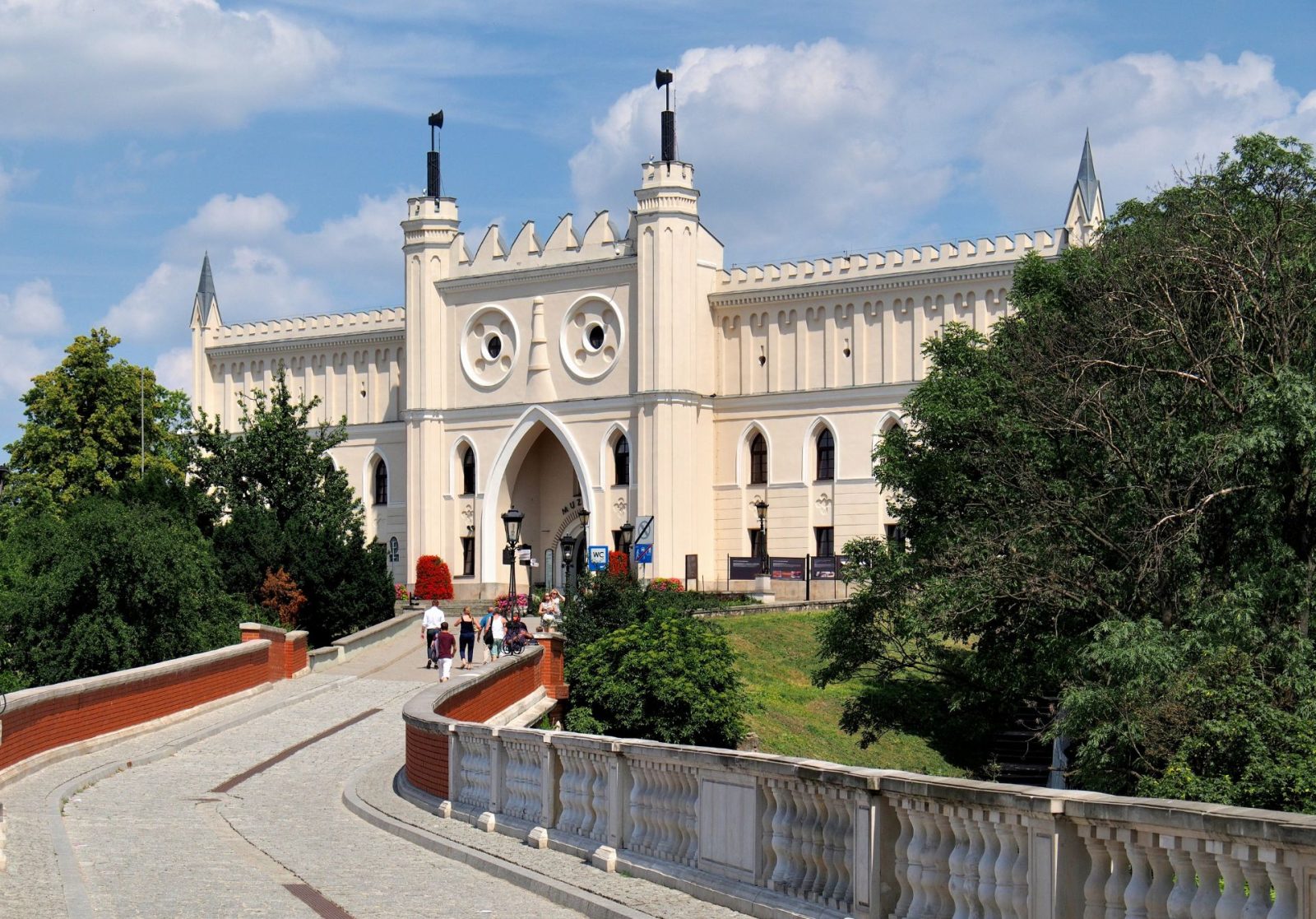
- 19th century: After centuries of wars and decline left much of the original castle in ruins, a sweeping neo-Gothic reconstruction between 1824 and 1826 gave the building its present-day appearance — a bold, turreted façade with crenellation and polyhedral turrets that make it unmistakable on the Lublin skyline.
The Moment That Changed European History
Of all the events that unfolded within Lublin Castle’s walls, one stands above the rest. On 1 July 1569, the castle was the venue for one of the most consequential political acts in European history: the signing of the Union of Lublin.
This agreement formally united the Kingdom of Poland and the Grand Duchy of Lithuania into a single state — the Polish-Lithuanian Commonwealth — creating what was, at the time, one of the largest and most populous countries in Europe. King Sigismund II Augustus and his court had based themselves at the castle for almost a year, receiving parliamentary deputies and foreign envoys as the negotiations unfolded.
🏛️ Did you know? The Union of Lublin is considered the first real interstate union concluded in Europe — a political achievement so significant that the site has been awarded the prestigious European Heritage Label, alongside the castle’s Holy Trinity Chapel.
The Crown Jewel: The Chapel of the Holy Trinity
If there’s one single reason to visit Lublin Castle, it’s the Chapel of the Holy Trinity — and it more than lives up to the hype. This Gothic chapel, tucked into the northeastern corner of the castle complex, houses a complete cycle of medieval frescoes that are genuinely jaw-dropping.
What makes the chapel so extraordinary is the fusion of styles on display. The architecture is classically Western Gothic, but the interior paintings are entirely Byzantine-Ruthenian in style — richly coloured, hieratic figures with golden backgrounds, depicting scenes from the Bible and the lives of saints. This east-meets-west combination is virtually unique in European sacred art, and it places the chapel firmly in the ranks of must-see medieval monuments on the continent.
- The frescoes were commissioned by King Władysław II Jagiełło and completed in 1418 by Ruthenian masters.
- They survived wars, fires, and centuries of neglect — a remarkable feat of preservation.
- The chapel has been awarded the European Heritage Label in recognition of its unique cultural and historical significance.
- Visitor numbers are managed carefully, so it’s worth booking your chapel visit in advance, especially in summer.
A Dark Chapter: The Castle as Prison
Not all of Lublin Castle’s history is glorious. For a period of 128 years, it functioned as one of Poland’s most notorious prisons — a fact that adds a sobering but important dimension to any visit here.
Following the Congress of Vienna in 1815 and Lublin’s absorption into Russian-controlled Congress Poland, the ruined castle was rebuilt not as a royal residence but as a Tsarist penal facility. Its grim incarnations across the 19th and 20th centuries include:
- Tsarist prison (1831–1915): Primarily used to hold Polish independence fighters and political dissidents, including the renowned writer Bolesław Prus (pen name of Aleksander Głowacki).
- Polish penal prison (1918–1939): Housed criminal and political prisoners during the interwar period of Polish independence.
- Nazi Gestapo prison (1939–1944): During the German occupation, between 40,000 and 80,000 people — mainly resistance fighters and Jewish civilians — were imprisoned here. Many were transported to nearby Majdanek concentration camp. On 22 July 1944, just before the Nazi withdrawal from Lublin, over 300 prisoners were executed within the castle walls.
- Communist investigative prison (1944–1954): Under Soviet oversight and later the Polish communist regime, approximately 35,000 Poles who opposed the new government were held here. Of the 515 death sentences passed, around 180 were carried out.
The castle prison was finally closed in 1954. Today, exhibits within the museum acknowledge this dark history, giving visitors the space to reflect on the human cost of the political upheavals that swept through Poland across the 20th century.
What to See and Do at Lublin Castle Today
Since 1957, Lublin Castle has served as the home of the National Museum in Lublin (Muzeum Narodowe w Lublinie), and it’s a genuinely impressive institution. The collections are wide-ranging, and there’s enough on offer to fill a satisfying half-day visit.
Here’s a quick rundown of the permanent highlights:
- The Chapel of the Holy Trinity — Guided tours available; the frescoes are the unmissable centrepiece of any visit.
- Polish painting and decorative arts — A strong collection spanning the 17th to 20th centuries, including notable works associated with Art Deco icon Tamara Łempicka.
- Historical arms and armour — A well-presented weaponry exhibition tracing Poland’s military heritage.
- The Lublin Tribunal exhibition — Dedicated to the history of the Crown Tribunal, one of Poland’s highest judicial bodies, which once met in Lublin.
- Coins and medals from Polish lands — A numismatic collection of real depth and detail.
- Folk art and prehistory of the Lublin region — A grounding introduction to the local area’s long and layered cultural history.
- The Donjon tower — Climb the Romanesque keep for panoramic views across Lublin’s rooftops and beyond. Absolutely worth the effort on a clear day.
💡 Concierge tip: Guided tours covering three key exhibitions can be completed in about 45 minutes — ideal if you’re on a tight schedule. But if you want to fully absorb the chapel and museum collections, budget at least 2–3 hours. The castle is adjacent to the Old Town, so pair it with a walk through Lublin’s beautiful historic centre for a full day out.
Practical Tips for Your Visit
Getting the most out of Lublin Castle is easy with a little planning. Here’s what you need to know:
- Location: The castle sits on Castle Hill (Wzgórze Zamkowe), right next to Lublin’s Old Town — it’s easy to reach on foot from the city centre.
- Getting there: Lublin is well connected by train from Warsaw (around 2–2.5 hours), making it a very manageable day trip or short break from the capital.
- Opening hours: The museum is generally open Tuesday to Sunday, with reduced hours on certain public holidays. Always check the official museum website before your visit for up-to-date times.
- Tickets: Entrance fees are reasonable and often include combined tickets for the museum and chapel. Group and student discounts are available.
- Best time to visit: Spring and early autumn are ideal — the weather is pleasant, and the summer peak crowds are either yet to arrive or have thinned out. The castle courtyard is particularly atmospheric in the golden light of late afternoon.
- Language: Most exhibits have English-language descriptions, and English-speaking guided tours can be arranged in advance.
- Accessibility: Parts of the castle have improved accessibility, though the medieval Donjon tower involves a steep climb.
The Bottom Line: Why Lublin Castle Belongs on Your List
Lublin Castle is one of those rare places that earns its reputation many times over. In the space of a single visit, you can stand where Polish and Lithuanian nobles once debated the future of a continent-spanning empire, marvel at Byzantine frescoes that have survived for over 600 years, reflect on the harrowing stories of those imprisoned here within living memory, and climb an 800-year-old Romanesque tower for a sweeping view of one of Poland’s most characterful cities.
It’s a place that layers joy and sorrow, grandeur and grimness — all within a compact, beautifully presented site that’s genuinely accessible and free of the overwhelming tourist crowds found at Poland’s bigger attractions.