Grodzka Gate
If you’re planning a trip to Lublin and you only have time for one stop, make it Grodzka Gate. This unassuming medieval archway tucked between old townhouses is so much more than a pretty relic — it’s a portal into centuries of layered history, cultural collision, and quiet resilience. Whether you’re a history buff, a casual traveller, or someone in the concierge business looking to offer clients genuinely meaningful experiences, Grodzka Gate deserves a prime spot on your radar.
Lublin itself is one of Poland’s most underrated destinations — a university city brimming with baroque architecture, cobblestoned laneways, and the kind of deep historical complexity that keeps curious visitors coming back. And at the heart of it all, literally and metaphorically, stands Grodzka Gate.
A Brief History: From Fortress Gate to Cultural Icon
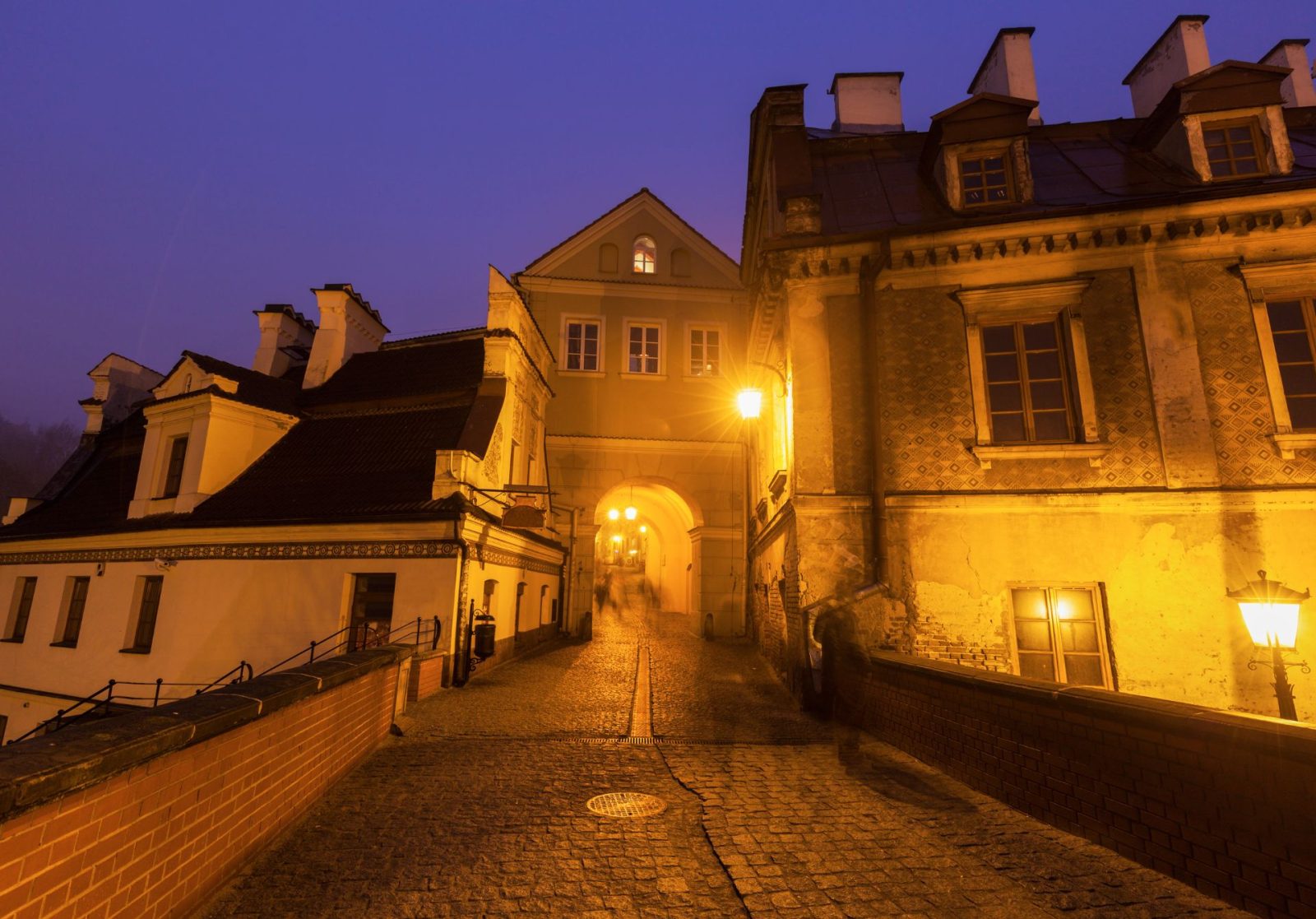
Grodzka Gate has been standing in some form since the medieval era, originally serving as one of the main entrances through Lublin’s city fortifications. Its Gothic bones date to the 14th century, though the structure has been rebuilt and renovated several times over the centuries.
In the 1560s, a gatepost was added to support a wooden drawbridge connecting the Old Town to Lublin Castle nearby. By the 1580s, the passageway had been fully vaulted, giving it a more fortress-like character. Parts of the surrounding city walls eventually collapsed due to water damage, requiring a major reconstruction into a two-storey form with a gabled roof — the silhouette you can still recognize today.
The most visually striking chapter came in 1785, when King Stanislaus II August Poniatowski funded a Classicist-style renovation, overseen by the celebrated architect Domenico Merlini. The date MDCCLXXXV (1785) and the royal monogram “SAR” (Stanislaus Augustus Rex) still appear on the facade facing the Old Town — a quiet nod to royal patronage amid centuries of stone.
The “Jewish Gate”: A Border Between Two Worlds
One of the most compelling aspects of Grodzka Gate’s history is its role as a symbolic — and very real — dividing line. For centuries, the gate marked the boundary between Lublin’s Christian Old Town within the walls and the Jewish district of Podzamcze that lay beyond it.
Locals long referred to it simply as “the Jewish Gate.” It wasn’t a wall of separation in a hostile sense — the two communities coexisted, traded, and lived side by side — but the gate was a very tangible threshold between two distinct cultural worlds. By 1939, Lublin’s Jewish community numbered approximately 43,000 people, representing about a third of the city’s total population.
That community was systematically destroyed during the Nazi occupation of World War II. The Jewish quarter of Podzamcze was liquidated, its synagogues demolished, its streets erased. Today, where houses and markets once stood, there is a parking lot, a main road, and a concrete silence. The gate stands at the edge of that absence — and that’s exactly what makes visiting it so affecting.
The NN Theatre Centre: Keeping Memory Alive
Since 1992, Grodzka Gate has been home to one of Poland’s most innovative cultural institutions: the “Grodzka Gate – NN Theatre” Centre. The “NN” comes from the Latin meaning “no name” — a deliberate reference to the unnamed victims of the Holocaust whose identities have been partially lost to history.
The Centre was established when a group of theatre enthusiasts moved into what was then a derelict building and began staging performances. It was, remarkably, the very first cultural institution to open in Lublin after the fall of communism in 1989. Over the following decades, it evolved into something much larger: an archive, a museum, an education centre, and a living memorial.
Today, the Centre’s activities span three connected locations:
- Grodzka Gate itself — home to the permanent exhibition “Lublin: Memory of the Place,” dedicated to the multicultural life of pre-war Lublin
- The Lublin Underground Trail — a 280-metre route through 16th-century cellars beneath the Old Town Market Square, featuring scale models of the medieval city and a dramatic recreation of the Great Fire of Lublin (1719)
- The House of Words (Dom Słów) — a space dedicated to literary and oral heritage on Żmigród Street
What You’ll Actually See Inside
So what’s the experience like for a visitor? Honestly, it’s unlike most museum visits. The curators have put enormous thought into how the space communicates its weight without overwhelming you.
The permanent exhibition is divided into three sections:
- Before 1939 — a rich portrait of Jewish Lublin: photographs, documents, reconstructed street maps, and personal testimonies that bring the pre-war community to vivid life
- The Holocaust — a memorial section commemorating the 43,000 Jews murdered during the liquidation of the Lublin ghetto, with metal archive boxes lining the walls and photographs visible only through small spyholes — forcing an intimate, one-to-one encounter with individual faces
- The Righteous Among the Nations — stories of those who risked their lives to protect Jewish neighbours during the occupation
There’s also a stunning scale model of the pre-war Jewish district, showing the dense network of houses, synagogues, and market streets that once occupied the now-empty space on the other side of the gate. Seeing it makes the present-day absence feel even more tangible.
Planning Your Visit: Tips for Travellers
If you’re recommending Grodzka Gate to clients or planning your own itinerary, here’s what you need to know:
- Guided tours in English run Monday to Friday at 12:00 noon — no need to speak Polish to get the full experience
- Tours are also available in Ukrainian and German for groups, with advance booking via phone (+48 81 532 58 67) or email (sklep@tnn.lublin.pl)
- Opening hours are Monday–Friday, 9am–5pm, with Saturday tours at 10am — plan accordingly if you’re visiting over a weekend
- Tickets can be purchased online via the Centre’s official website at teatrnn.pl, making it easy to skip any queues
- Combine with the Underground Trail for a full half-day immersion in Lublin’s history — the two experiences complement each other beautifully
- The gate is steps away from Lublin Castle and the Old Town Market Square, making it easy to weave into a broader walking tour of the city
Why This Place Matters Beyond Tourism
It would be easy to slot Grodzka Gate into a standard “must-see monuments” list and move on. But what makes it genuinely special — and what distinguishes it from a purely architectural attraction — is the way it insists on memory as an active, ongoing project.
The NN Theatre Centre has spent over three decades reconstructing identities: digitising old photographs, recording oral testimonies, mapping pre-war addresses, and naming the unnamed. Their digital archive now contains reconstructed addresses of Jewish families going back to 1800, an interactive 3D model of Lublin as it looked in 1939, and location maps of Holocaust memorial sites across the city.
In 2004, one of the last surviving gas lamps from pre-war Lublin was installed near the gate as a permanent eternal flame — lit day and night — in memory of the vanished Jewish quarter. It’s a small detail, but a deeply moving one.
For travellers who want more than beautiful facades — who want to understand a place — this is exactly the kind of destination that stays with you long after you’ve gone home.
Final Thoughts: Don’t Skip This One
Grodzka Gate is one of those rare travel experiences that manages to be architecturally beautiful, historically rich, and emotionally resonant all at once. It’s a 14th-century Gothic gateway that has witnessed the full sweep of Central European history — medieval trade, royal patronage, multicultural coexistence, catastrophic destruction, and painstaking remembrance.
For anyone visiting Lublin — or advising others who are — it absolutely belongs at the top of the list. Set aside at least two hours, book an English-language guided tour, and consider pairing it with the Underground Trail for a deeply layered half-day in one of Poland’s most historically complex cities.
Whether you approach it as an architectural landmark, a Holocaust memorial, a living cultural institution, or simply a remarkably evocative old building at the heart of a fascinating city, Grodzka Gate will not disappoint. Some places just have more to say than others. This is one of them.