Old Market Square (Rynek)
Your insider guide to the beating heart of one of Poland’s most captivating — and under-visited — historic cities
If you’ve been to Warsaw or Kraków and think you’ve “done” Poland, it’s time for a reality check. Lublin’s Old Market Square — known locally as the Rynek — is the kind of place that stops you mid-stride, camera half-raised, wondering how you never heard of it before. Cobblestoned, colourful, and absolutely buzzing with life, this is a square that rewards slow exploration. Whether you’re a history buff, a foodie, a photographer, or just someone who appreciates a well-placed café and a cold Polish beer, Lublin’s Rynek has something for you.
Often dubbed “little Kraków,” Lublin is in fact its own beast entirely — arguably more authentic, less crowded, and packed with a cultural complexity that stems from centuries of sitting at the crossroads of Central and Eastern Europe. And the Rynek sits right at the centre of all of it.
A Square Almost 700 Years in the Making
Let’s start with a bit of history, because understanding this square’s past genuinely makes walking around it feel like a superpower. The Old Market Square was established following Lublin’s granting of town charter rights on 15 August 1317 by King Władysław the Short. That means this square has been the civic, commercial, and social heart of the city for nearly seven centuries.
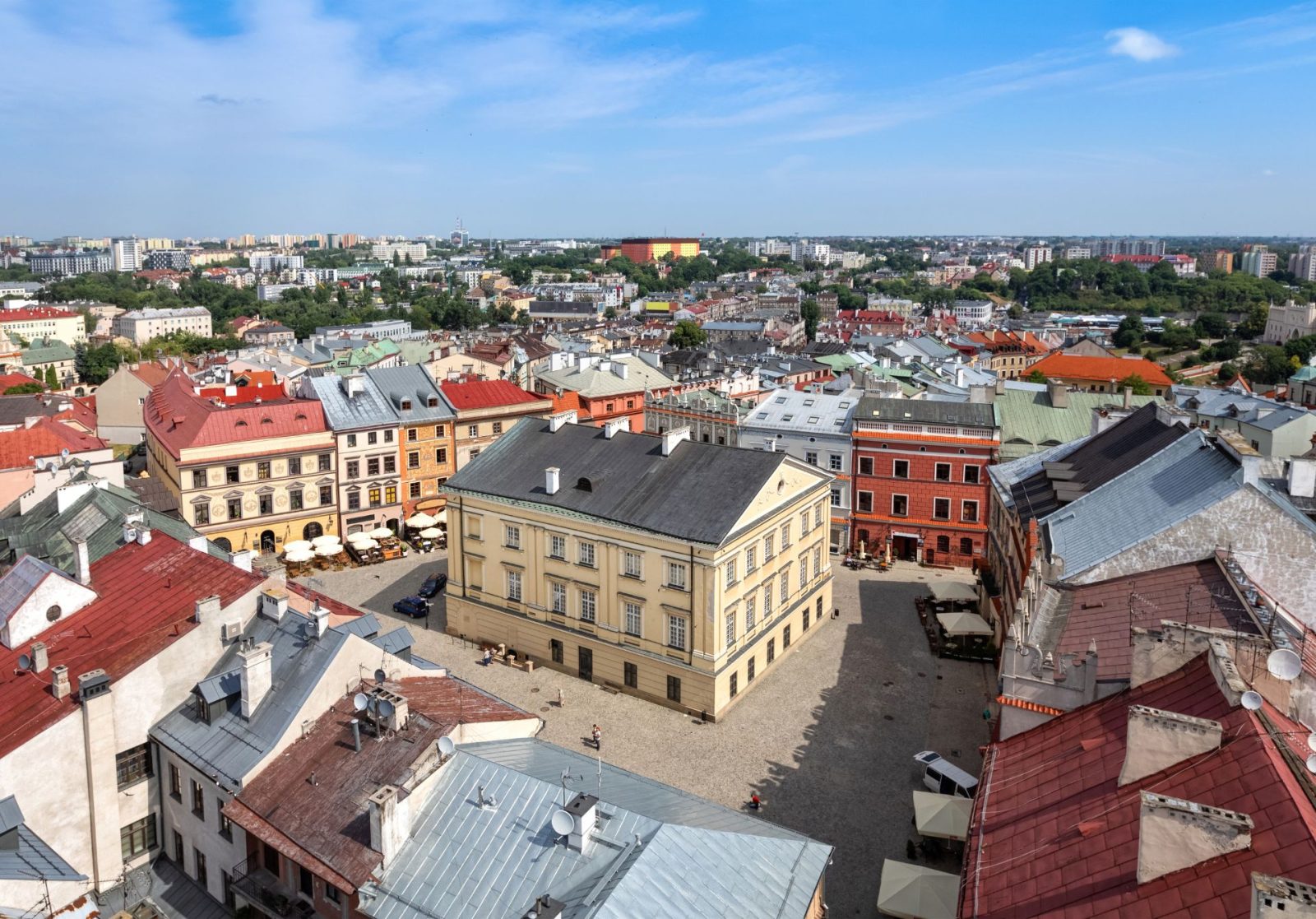
The square itself isn’t perfectly rectangular — it forms a rough trapezoid, measuring approximately 62 by 72 metres. That irregular shape is the result of its location on the curve of the city’s former fortified walls, giving the western frontage a concave form and the eastern side a convex one. It’s a quirk that gives the space a surprisingly intimate, enclosed feel despite its considerable size.
Originally, markets and trade were the whole point. Medieval Lublin was a significant commercial hub, and the Rynek was the engine driving it. In 1575, a devastating fire swept through the city and burned down much of the original wooden construction. What rose from the ashes was arguably even better — grand stone and brick tenement houses that still line the square today, many of them bearing their original Renaissance and Baroque ornamentation. A walk around the perimeter reveals facades spanning architectural styles from Gothic right through to Neoclassicism, each building with its own story to tell.
“Strolling around the market square feels like a walk back in time, when Lublin was a bustling city on the crossroads between Central and Eastern Europe.” — Visitor review
The Crown Tribunal: The Star of the Show
Standing plumb in the centre of the Rynek is the Crown Tribunal building — arguably the most important structure in the square, and one that’s witnessed more drama per square metre than most places in Poland. Originally built as a wooden Gothic town hall in the 14th century, it was destroyed in the fire of 1389 and rebuilt in brick. Over the following centuries it was remodelled multiple times — going through Renaissance, Baroque, and finally Neoclassical renovations — each transformation reflecting the politics and aesthetics of the era.
Its most significant moment came in 1578, when King Stefan Batory decreed it the seat of the Crown Tribunal, the highest court of appeal for the nobility of Lesser Poland. For centuries, nobles from across eastern Poland would descend on Lublin to settle their disputes here. It was glamorous, rowdy, and often thoroughly corrupt — giving rise to stories like the infamous Devil’s Trial of 1637, in which legend has it that the devil himself appeared to pass judgement when human judges failed. You can still hear this tale told by local guides who bring genuine theatrical flair to the story.
Today, the Crown Tribunal serves as:
- A Wedding Palace, where couples can marry in one of the most historically loaded settings in all of Poland
- The entrance to the Lublin Underground Route — one of the city’s most popular attractions (more on that shortly)
- A cultural events venue, hosting concerts, exhibitions, and civic gatherings in its magnificent Great Hall
- A small museum charting the history of the town hall and the Tribunal itself
It’s a remarkable building that manages to be simultaneously a piece of living history, a practical civic space, and a tourist attraction. Don’t just photograph it from the outside — get inside.
The Tenement Houses: Every Facade Tells a Story
Once you’ve taken in the Crown Tribunal, turn your attention to the four frontages of the square, lined with tenement houses that range from lovingly restored to pleasingly weathered. Each one has a name, a pedigree, and usually a legend or two attached to it.
- The Lubomelski Family House (No. 8) — One of the most celebrated buildings on the square, this has been associated with the Lubomelski family since the early 16th century. The portal bears the “Zadora” house mark dated 1540. It was rebuilt after the 1575 fire and its basement — originally a wine bar — was decorated with wall paintings that still impress today.
- The Klonowic Family Tenement House — An ornate Renaissance facade featuring carved portraits of notable Lublin-associated poets between the first-floor windows. Look carefully and you’ll spot likenesses of Biernat from Lublin, Jan Kochanowski, Sebastian Klonowic, and Wincenty Pol.
- The Konopnica Frontage (No. 12) — The fancy blue tenement house once home to Mayor Konopnica, and the source of one of Lublin’s more colourful legends. Local folklore claims that a nobleman who lived here made a deal with the devil to win a legal case — and paid the price accordingly.
- No. 4, Rynek — A recently renovated house with a particularly poignant story: replicas of photographs discovered in the building are now displayed in the windows of nearby streets, commemorating the Jewish community that once thrived here before World War II.
There’s also Plac Po Farze — a small square just off the Rynek where the foundations of the 14th-century Parish Church of St. Michael the Archangel are preserved as low symbolic walls. The church tower was once visible from several kilometres away; today a model of the entire building sits in the southern corner of the square for context. It’s a quietly moving space, especially at dusk.
Beneath Your Feet: The Lublin Underground Trail
One of the absolute must-dos when visiting the Rynek is descending into the earth beneath it. The Lublin Underground Trail is an approximately 280-metre route created by connecting a dozen historic cellars, some dating back to the early 16th century. It runs under the Market Square and surrounding tenement houses, and it’s genuinely one of the most atmospheric underground experiences in Poland.
The trail features:
- An exhibition of scale models showing Lublin’s urban development from the early Middle Ages (8th–10th century) through to the 18th century
- A dramatic light-and-sound recreation of the Great Lublin Fire of 1575 — the centrepiece of the underground experience
- Fascinating insights into the city’s medieval commercial and social life
- The chance to explore actual cellars once used for trade, wine storage, and — more grimly — as holding cells
This trail is enormously popular, and for good reason. Book well in advance — at least a week ahead during peak season — and note that winter weekend availability is more limited than summer. The entrance is through the Crown Tribunal building.
Eating and Drinking on the Rynek: A Very Good Problem to Have
The square and its immediately surrounding streets are lined with some of the best eating and drinking options in the city. Given that students make up roughly 35% of Lublin’s population, you can expect a dining scene that punches above its weight in quality while remaining refreshingly affordable by Western European standards.
Here are some top picks to get you started:
- Mandragora — An atmospheric restaurant serving authentic Jewish cuisine, a nod to Lublin’s extraordinary multicultural heritage. Highly regarded and genuinely moving in its cultural significance.
- Niepospolita — A fantastic art-deco Polish restaurant just off the square, offering a beautifully curated take on traditional Polish cooking.
- Trybunalska City Pub — A unique hybrid of restaurant, bakery, and brewpub right on the Rynek, perfect for a lazy afternoon of pierogis and local craft beer.
- Cafe Lulu — A cosy, unpretentious café-bar on the square with an excellent atmosphere, popular with locals and tourists alike. Great for coffee or a late-evening drink.
- Akwarela — A charming little coffee spot for those who need caffeine and calm after a long day of exploring cobblestones.
If you’re looking for nightlife, the streets radiating off the Rynek — particularly Grodzka and Złota — are where things get interesting after dark. The bar Underground (fittingly named) is a local favourite for cocktails and atmosphere, while Bagatela Pub is the go-to for craft beer enthusiasts.
Nearby Landmarks You Shouldn’t Miss
The Rynek is the perfect launchpad for exploring the wider Old Town, which is extraordinarily compact — several dozen monuments within less than a square kilometre. Don’t leave without seeing:
- The Krakowska (Cracow) Gate — The medieval fortress gate at the entrance to the Old Town, a proud symbol of the city and one of its most photographed landmarks
- The Dominican Basilica and Monastery — At the end of ul. Złota, this stunning complex dates from the mid-1300s and houses a famous painting depicting the Great Fire of Lublin
- The Trinitarian Tower — Visible from the Rynek, this offers one of the best elevated views over the Old Town
- Lublin Castle and the Holy Trinity Chapel — A short walk from the Rynek, with breathtaking Gothic-Byzantine frescoes that are among the finest in Central Europe
- Grodzka Gate — Once the boundary between the Christian and Jewish quarters of the city, now a moving cultural centre dedicated to preserving the memory of Lublin’s Jewish heritage
Practical Tips for Visiting
A few concierge-level tips to make sure your visit to the Rynek goes as smoothly as possible:
- Best time to visit: Summer (June–August) is the liveliest, with outdoor events, concerts, and festivals filling the square. Autumn offers beautiful colours and smaller crowds. Winter is quieter but wonderfully atmospheric.
- Getting there: Lublin is about 170 km southeast of Warsaw, with regular train and bus connections. The Old Town is easily walkable from the main train and bus stations (approximately 20–30 minutes on foot, or a short taxi/rideshare ride).
- Underground Trail bookings: Book online in advance, especially for summer visits. Weekend winter tours fill up fast.
- Footwear: Cobblestones are beautiful and brutal in equal measure. Comfortable walking shoes are non-negotiable.
- Walking tours: A guided Old Town walking tour (typically 3 hours) is an excellent investment, offering context and stories you simply won’t get wandering alone. Several operators offer tours ending with a break at a local confectionery — a delightful touch.
- Evening visits: The Rynek is particularly beautiful after dark when the buildings are lit up. Plan to stay for dinner and drinks as the square comes alive in the evenings.
The Bottom Line: Why the Rynek Belongs on Your Poland Itinerary
Lublin’s Old Market Square is not a second-tier attraction for travellers who’ve already exhausted Warsaw and Kraków. It’s a destination in its own right — a place where nearly 700 years of Polish, Jewish, and multicultural history converge in a single, remarkably well-preserved public space. From the Crown Tribunal’s centuries of drama to the haunting beauty of the underground cellars, from the Renaissance tenement facades to the modern-day bustle of café terraces and craft beer bars, the Rynek offers an experience that is at once deeply historical and thoroughly alive.